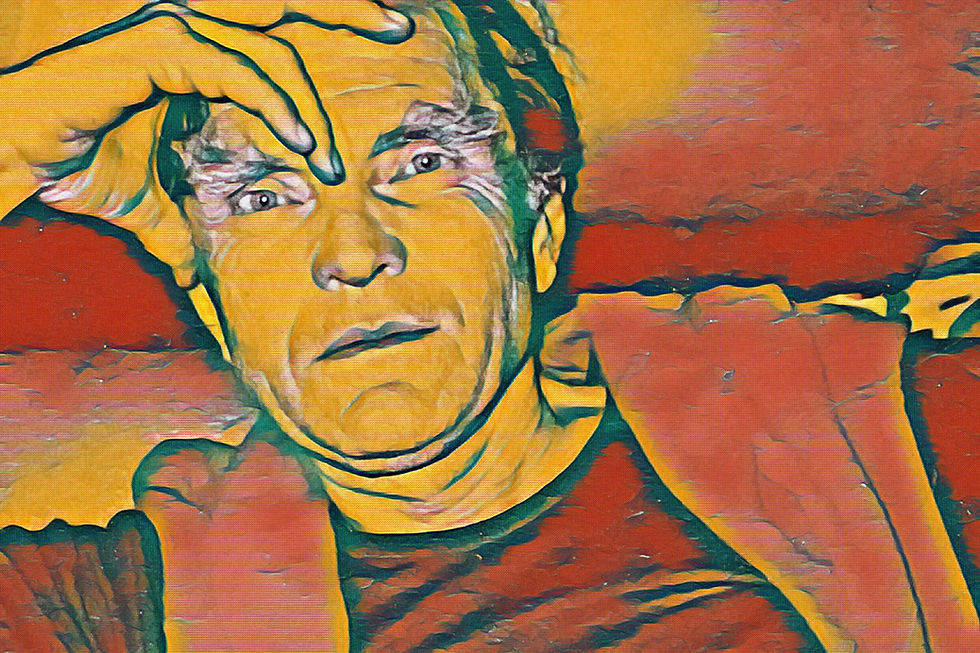
If You Meet Feyerabend on the Road, Kill Him

‘The room was full of people who seemed to believe I was a star, something I just could not comprehend.’
Paul Feyerabend1
This essay is a follow on from my previous piece, Not this, Not that: The Mystical Pluralism of Paul Feyerabend.2 In it, I explored the life and work of the famous philosopher through the lens of mystical philosophy; in particular the Hindu school of Advaita Vedanta.
I proposed that the practice of vicāra jñāna, or self-inquiry, where a person turns their attention within to examine their core witnessing awareness, sākṣī, could be a kind of master key in cultivating an ability to step out of absorption by paradigms. In other words, it facilitates the pluralism Feyerabend advocates.
I further contended that Feyerabend adds back to Advaita. Far from the otherworldly, transcendent spiritual philosophy it is usually perceived as, it becomes the thing that allows us to transcend our paradigms and embrace the ‘undiluted madness’ that are other people’s opinions.
I did, however, also acknowledge that there may also exist tensions and contradictions between Feyerabend’s philosophy and Advaita Vedanta, which I promised to explore in a further essay. This is that essay.
Feyerabend was famously sceptical of anything that asserts itself as a foundation, anything that is ‘true’ irrespective of the perspective taken. Vedantans would say that is exactly what the witnessing awareness they call sākṣī is. It isn’t a paradigm or concept, it’s the thing that paradigms and concepts rise up and fall away in. I wonder if Feyerabend might have suspected a new absolute was being snuck in here. Like a revolutionary freedom fighter who comes to take power: the thing that frees us from the tyranny of our concepts becomes an even more terrible tyrant lording it over us.
If this is what Feyerabend would have thought: then I would assert that he’d have been right.
Anyone who spends any time around people invested in Advaita Vedanta can’t help but notice that sākṣī becomes just another concept, a paradigm to cling to. Even if it is not truly a concept, the human mind is very capable of turning it into one.
Spiritual teaching across traditions has recognised this and cautioned against this. Sri Nisargadatta Maharaj advised a person to ‘discard everything, including “I am awareness”’. The Tao Te Ching opens by informing the reader that: ‘The Tao that can be spoken is not the eternal Tao’. In Zen, this problem might be addressed with a koan, such as the Stone Mind. A teacher points to a large rock and asks his student whether it is inside or outside the mind. The student replies:
‘According to Buddhist philosophy, all things are mental phenomena, therefore I conclude the stone is inside my mind.’
To which the teacher counters:
‘Your head must feel very heavy carrying that large stone around!’
The student was not necessarily wrong, rather he was stuck inside a conceptual understanding—stuck in a paradigm. The teacher used humour, silliness and indifference to truth to jolt him out of this.3
The title of this essay is a play on a phrase from a 9th century Zen Buddhist, Linji Yixuan, who wrote: ‘If you see Buddha on the road, kill him.’ Not to be taken literally (the Buddha had been dead for fifteen hundred years by that time), it is a caution against making an idol of a person or doctrine or a concept—irrespective of however true that concept might be.
After writing Against Method, Feyerabend became aware of this trap:
‘One of my motives for writing Against Method was to free people from the tyranny of philosophical obfuscators and abstract concepts such as “truth”, “reality”, or “objectivity”, which narrow people’s vision and ways of being in the world. Formulating what I thought were my own attitude and convictions, I unfortunately ended up by introducing concepts of similar rigidity, such as “democracy”, “tradition”, or “relative truth”.’4
Advaita and Zen have different ways of addressing this problem. Advaita aims to be very philosophically precise, whereas Zen will employ humour and irreverence, and is not even averse to deliberate error in order to shake a conceptual understanding.
Feyerabend perhaps introduces a different way of dealing with the problem, that of proliferation: employing more than one theory at the same time in order to see them all more clearly.
This approach is antithetical to most schools of mysticism, which are highly rooted in the absolute nature of one particular philosophical approach. Proliferation, of a sort, however, does arise naturally in aspirants' spiritual journeys.
In his book, From Guru to God, the highly experienced yogi Michael Graham describes his sudden conversion to an evangelical form of Christianity. This was not a plastering over of Eastern mysticism with Christian language, but a firm rejection of the former in favour of the latter. He goes on to describe how this conversion led him to a sense of ‘existential rest’ for the first time.5
Moving in a different direction, contemporary spiritual philosopher Tim Freke also rejected the perennial mysticism his work was grounded in. In his case, however, he embarked on a project to reconcile spirituality with a scientific understanding of the world.6
Both of these transformations might be described in terms of a Thomas Kuhn style paradigm shift. There was a period of normal mysticism where anomalies were filed away until they became unignorable. Their acknowledgement gave rise to a period of crisis, resulting in a paradigm shift into a new and better theory. I say ‘new and better’, as both men report significant improvements in their new approach, even if those approaches directly contradict each other: with Graham moving towards the classically religious and Freke firmly away from it.7
Another way of interpreting this movement, however, is through the Feyerabendian lens of proliferation. Both men intuitively recognised that a mystical monotheory becomes a conceptual prison. Both broke out of that prison by creating a competing theory. Neither would (at least as of the time of their writing) view their work this way—and yet it is impossible to ignore that it can be received in exactly this manner. A spiritual aspirant might read both Graham and Freke, and benefit from both without being convinced by either. By stepping outside of the standard mystical paradigm, they have created the ability to critique it from an entirely other point of view.
In his critique of the linear nature of Kuhn’s account of science, Feyerabend writes of the necessary interplay of proliferation and tenacity:
‘Proliferation means that there is no need to suppress even the most outlandish product of the human brain. Everyone may follow his inclinations and science, conceived as a critical enterprise, will profit from such an activity. Tenacity: this means that one is encouraged not just to follow one's inclinations, but to develop them further, to raise them, with the help of criticism (which involves a comparison with the existing alternatives) to a higher level of articulation and thereby to raise their defence to a higher level of consciousness.’8
Feyerabend is talking about science as a collective pursuit, with each individual following their own inclinations. According to this, the kind of proliferation in mysticism we see Graham and Freke engaging in should be welcomed. Even if we disagree with them, it is still beneficial to the entirety of mystical studies.
There is, however, no reason not to apply the same idea to an individual embracing pluralism in their own mind, and holding a balance of proliferation and tenacity within themselves. What’s good for the group is surely good for the individual—in order to see from different perspectives and avoid dogma.9
We have a tendency to think we should simply adopt the ‘correct’ theory and run with that. Anything else would be a waste of time. It may be the case however, that there is no entirely correct description of reality, and what we are left with is a collection of flawed attempts, which liberate in some ways and confine in others. Moving between these flawed maps would then be the best way to go.
Even if there really is one true map to cling to, we still cannot help but mistake that map for the territory. It is not only the Buddha and Paul Feyerabend, then, but the very reification of Truth itself, that must be killed when we meet it on the road.
Notes
1. Killing Time, The Autobiography of Paul Feyerabend, page 177.
2. Not this, Not that: The Mystical Pluralism of Paul Feyerabend, by Richard Cox.
3. There are actually two levels on which this teaching story can be understood.* The other is that Zen master Hogen is actually not contradicting Buddhist philosophy, but actually picking up on two philosophical errors the monk has made. The monk says: ‘I conclude the stone is inside my mind’, but in Buddhist philosophy there is no inside/outside and no ‘I’ to whom the mind belongs. It can therefore also be seen that it is this sense of separation that Hogen is pointing to.
Paradoxically, the two interpretations both contradict and complement each other at the same time.
* There may be further ones of which I am incapable of understanding.
4. Killing Time, The Autobiography of Paul Feyerabend page 179.
5. From Guru to God: An Experience of the Ultimate Truth, by Michael Graham
6. Why Your Life Really Matters, by Tim Freke
7. A critic has pointed out that I have not qualified why the new approaches should count as better beyond Graham and Freke's first-person reports, and that proliferation in Feyerabend is justified by increased critical articulation rather than by feeling better—otherwise any paradigm shift could be justified by subjective improvement.
This is a real difficulty, and it is not unique to this essay. Much of mystical writing relies on first-person reports of inner states, a problem that can be recognised but never fully escaped. To go beyond this would require an essay on how we assess reports of spiritual experiences, which is very much beyond the scope of this one.
I take Graham and Freke’s reports seriously due to their level of experience and description of the before and after. Graham, for example, eloquently describes finding something that sounds very much like the experiential goal of Eastern spirituality through his encounter with Jesus. Freke has demonstrated how his ‘emergent’ approach to spiritual practice gives rise to differently interpreted experiences. In both cases, the move allows a critique of the earlier view from outside it, which is what Feyerabend means by raising a position to a higher level of consciousness.
8. Problems of Empiricism, Philosophical Papers Volume 2, page 143. by Paul Feyerabend.
9. A critic has pointed out that it is not, in fact, obvious, that ‘what's good for the group is surely good for the individual.’ And that: ‘Feyerabend's principle of proliferation is formulated for a community of researchers, each pursuing their own tenacious line, and that internalising both proliferation and tenacity within a single mind may lead to dilettantism rather than deeper criticism.’
This is a very interesting criticism. Why do I almost take for granted that proliferation within an individual is necessarily a good thing? Intuitively, I feel I can justify it, but we shall have to wait for another essay to find out.