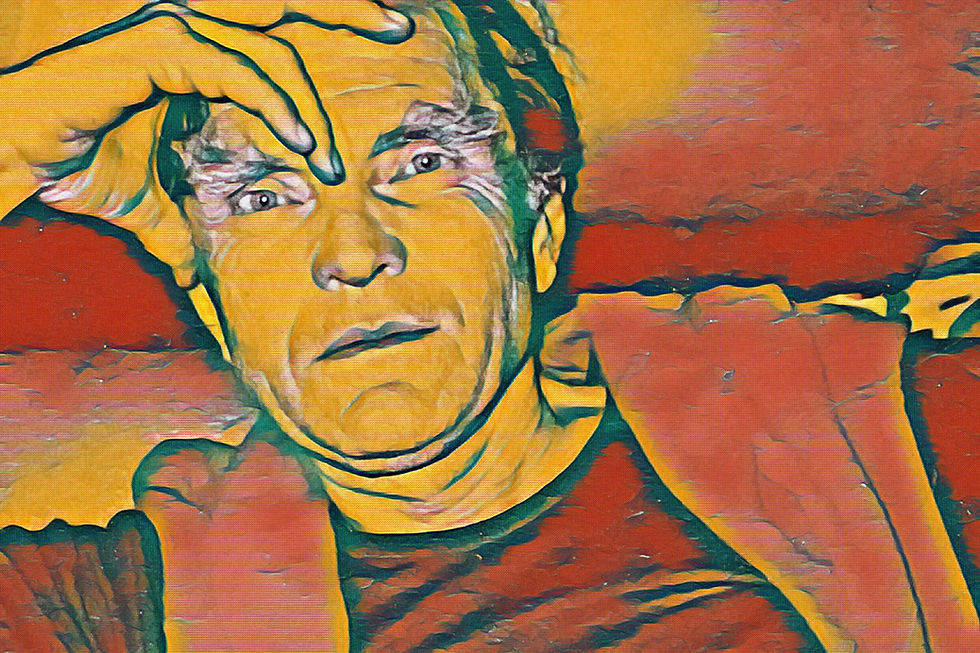
‘And He was a Firebrand!’ The Many Aptronyms of Paul Karl Feyerabend

‘For this reason, the Divine Mind is said to be an authority on the generation of names, and just as it is not reverent to transgress against the statues of the gods, so it is not holy to do wrong regarding names.’
Proclus1
An aptronym is a personal name that somehow captures something about its owner: usually regarding their personality, profession or character. They are often deliberately inserted into fiction, but also pop up, apparently randomly, in real life. So it’s not a coincidence that Cruella de Vil is indeed cruel, but it is a coincidence that the fastest man who ever lived is named Beautiful Bolt.2
Or so we suppose…
The opening quotation is from the Neoplatonic philosopher Proclus, commenting on Plato’s Cratylus. The Cratylus is a dialogue exploring if names are arbitrary, or whether they contain meaning relating to the thing they identify.
In the dialogue, Hermogenes contends that names have come about through custom and convention and have no real connection to the things they point to. Cratylus argues that there is a correct name for everything, like a correct key for every lock. Socrates tries to make sense of that by saying naming is an art: soft sounds should be used for soft things and hard for hard. Humans should strive for correspondence whilst recognising they will always fall short.
Three quarters of a millennium later, Proclus turned that art into theurgy, seeing names as arising from a divine author. Just as in fiction, they symbolically represent the characteristics a person brings into this world.
Children may be introduced to aptronyms by the famous Mr. Men books, where the various characters literally are their names. This pattern persists into adult literature, albeit in a more subtle way, where characters are also people beyond their defining trait.
Logically, it’s hard to understand why this is a thing. Why did Charles Dickens feel the need to lay this on so thick, with characters like Mr. Gradgrind, a harsh schoolmaster who grinds facts and numbers into the minds of his students? Why was Thomas Hardy so obvious in naming his dependable and deeply rooted shepherd character Gabriel Oak?
Rationally this seems silly—what could it possibly add to the story? Yet for some strange reason it feels like it has value. And not just to me, but obviously to the great literary minds of the ages—hence, they have used them.
Perhaps aptronyms can be best understood in Neoplatonic terms: if reality is mind-like and there is a world of ideas beyond this one, then naming a character Mr. Happy shows that he isn’t simply a man who is happy, he is happiness itself brought into form. Roger Hargreaves has in-formed happiness, in the same way that Dodie Smith in-formed cruelty in Ms. de Vil.
Far from being silly, then, the aptronym is a nod that breaks the fourth wall. It signals to the reader that they are not reading a story about fictional characters, rather they are reading about altogether real archetypal principles, as real in this world as in any other.
Occasionally there can be a double breaking of the wall, when a character in the story sees the symbol. In Spider-Man 2, when news-editor J. Jonah Jameson says: ‘A man named Otto Octavius winds up with eight limbs. What are the odds?’, the audience knows that ‘the odds’ had nothing to do with it.
We would typically have it then that aptronyms arise in literature through intent, and in this world through coincidence. This is easy to believe, as most people’s names do not have obvious symbolic value. It may cause us to momentarily pause that such a great English poet is called William Wordsworth, or laugh that Terry Boot replaced Peter Foot as boss of Shoe Zone. We may even find it profound that the couple who challenged segregated marriage were called Richard and Mildred Loving, leading to the court case literally being Loving v. Virginia. Unlike Proclus, however, we probably don’t see the workings of a Divine Mind behind these things.
But would we? In 101 Dalmatians no one ever points out that Cruella de Vil is cruel. Why not? It must be that they just don’t spot the aptronym. They are in the drama, assuming it’s a ‘real’ world and not a story. They see Cruella as a person, and not an in-forming of an archetype. They therefore don’t see the symbolism even when it’s right in front of their eyes. Would we see it when it is right before ours? Maybe not.
We take aptronyms as arising for two entirely different reasons depending on the setting: intentionally, in literature, and randomly, in the real world. Could it be the case that they are always intentional on some level, and that our world is really just another form of literature. Could aptronyms be one of the ways the fourth wall breaks—a way we can catch glimpses of this?
The philosopher Paul Karl Feyerabend not only suggested that we may inhabit some kind of dream world, but that excursions into ‘what at first looks like undiluted madness’ may be highly beneficial.3 Feyerabend also had one of the most compelling aptonyms imaginable. It’s almost obligatory when writing about him to point out that he was, indeed, a firebrand: an epistemological anarchist who sought to burn down the authoritarian structures of intellectuals. He has been compared to Diogenes, ‘the raving firebrand living on the street’, and even to Dionysus, the god of wine, ecstasy, fertility and frenzy.4
The aptronym only works in English, of course. In German Feierabend means ‘knocking-off time’. In his autobiography, Feyerabend reports that his paternal grandfather replaced the ‘i’ with a more exotic ‘y’. Fear not, however, as an entirely different symbolism emerges. Feyerabend ‘knocked-off’ from his whole career as a philosopher, writing that:
‘I forgot the thirty-five years of my academic career almost as quickly as I had forgotten my military service. I find it hard to believe that only five years ago I was teaching at two academic institutions, one in Europe, the other in California; that a little earlier I had had tenure at four universities, Yale among them; and that it had been up to me and not to committees to accept or reject further offers.’5
This ‘knocking-off’ from an illustrious career, from a whole identity as a philosopher, signifies something deep about who Feyerabend is. Being the great philosopher was never an essential part of his identity, he could let it go in an instant. Feyerabend overtly recognised this and passed it on to his students:
‘I had often warned my students not to identify with their work. I told them, “If you want to achieve something, if you want to write a book, paint a picture, be sure that the center of your existence is somewhere else and that it's solidly grounded; only then will you be able to keep your cool and laugh at the attacks that are bound to come.”’6
More than this, the book Feyerabend discusses the meaning of his name in is his autobiography: Killing Time. He writes about life itself as something to ‘knock-off’ from, as if he sensed his essential identity was something deeper again.
This almost flippant attitude has a ring of the 12th-century Chinese Zen monk Dahui Zonggao. There was a tradition amongst monks to write a poem before they died. Under pressure to do so, he called for his brush and said:
‘Without a verse, I couldn't die.’
Then, contradicting his apparent seriousness, he wrote:
‘Birth is thus
Death is thus
Verse or no verse,
What's the fuss?’
So it turns out Feyerabend is an equally potent aptronym in both English and German. To take things further still: Paul means humble, whilst Karl is a free man. As a philosopher, Feyerabend was anything but humble. As a man, Paul was entirely humble, writing of how he was ‘amazed when interviewers treat me as if I were an oracle, a shaper of ideas’, and how he would eschew intellectual conversation to ‘help with the dishes’.7 ‘Karl’ writes itself, and also evokes Feyerabend’s relationship with his mentor turned opponent Karl Popper. Whose philosophy really represented freedom?
And so we will conclude this excursion into ‘undiluted madness’. It seems that we simply can’t know through any rational process whether aptronyms are arising coincidentally or as part of a narrative structure. Depending on our proclivities we may have feelings about it one way or the other.
Logically, we have to be Hermogenes. We would otherwise go mad, drowning in an ocean of symbols. Mythically, we can occasionally be Proclus, dipping our toes in at the water’s edge. The world may in fact be drenched in symbolism which we just catch little glimpses of sometimes. To see a little lets us know we are in a show, to see too much would ruin the show.
Notes
1. On Plato Cratylus, by Proclus. Translated by Brian Duvick. I have changed ‘lawgiver’ ( nomothetes )to Divine Mind for the modern context.
2. I am of course referring to Usain Bolt. In Arabic the name Usain derives from ‘beauty’, which makes the lightning comparison all the stronger.
3. Farewell to Reason (1987), Chapter One, Notes on Relativism, page 22:
‘Even our most basic assumptions, our most solid beliefs, and our most conclusive arguments can be changed—improved or defused, or shown to be irrelevant—by a comparison with what at first looks like undiluted madness.’
And:
Against Method (1975), Chapter 2, page 22:
‘We need a dream-world in order to discover the features of the real world we think we inhabit (and which may actually be just another dream-world).’
4. Irrational Science Breeds Irrational Law, by Caleb Small
‘If [Thomas] Kuhn was a Socrates, artfully demonstrating that the world was not quite how his audience imagined, then Feyerabend was a Diogenes, the raving firebrand living on the street, advising a thoroughly skeptical worldview to the point of solipsism. Feyerabend intended to set the scientific method on fire before throwing it out the window. In Against Method, he argued that “aesthetic criteria, personal whims and social factors have a far more decisive role in the history of science than rationalist or empiricist historiography would indicate.”107 For Feyerabend, science cannot be explained by a single model; the only rule of science is that “anything goes.”’
And:
5. Killing Time, The Autobiography of Paul Feyerabend, by Paul Feyerabend.
6. Killing Time, The Autobiography of Paul Feyerabend, by Paul Feyerabend.